
Five ways teams put CONTINUUM to work
Most teams arrive with one question: a migration deadline, an audit request, or certificates nobody can account for. Each answer starts in the same place: an inventory of the cryptography you run, held against policy.
Post-quantum migration planning
Plan the migration from an inventory, not a guess
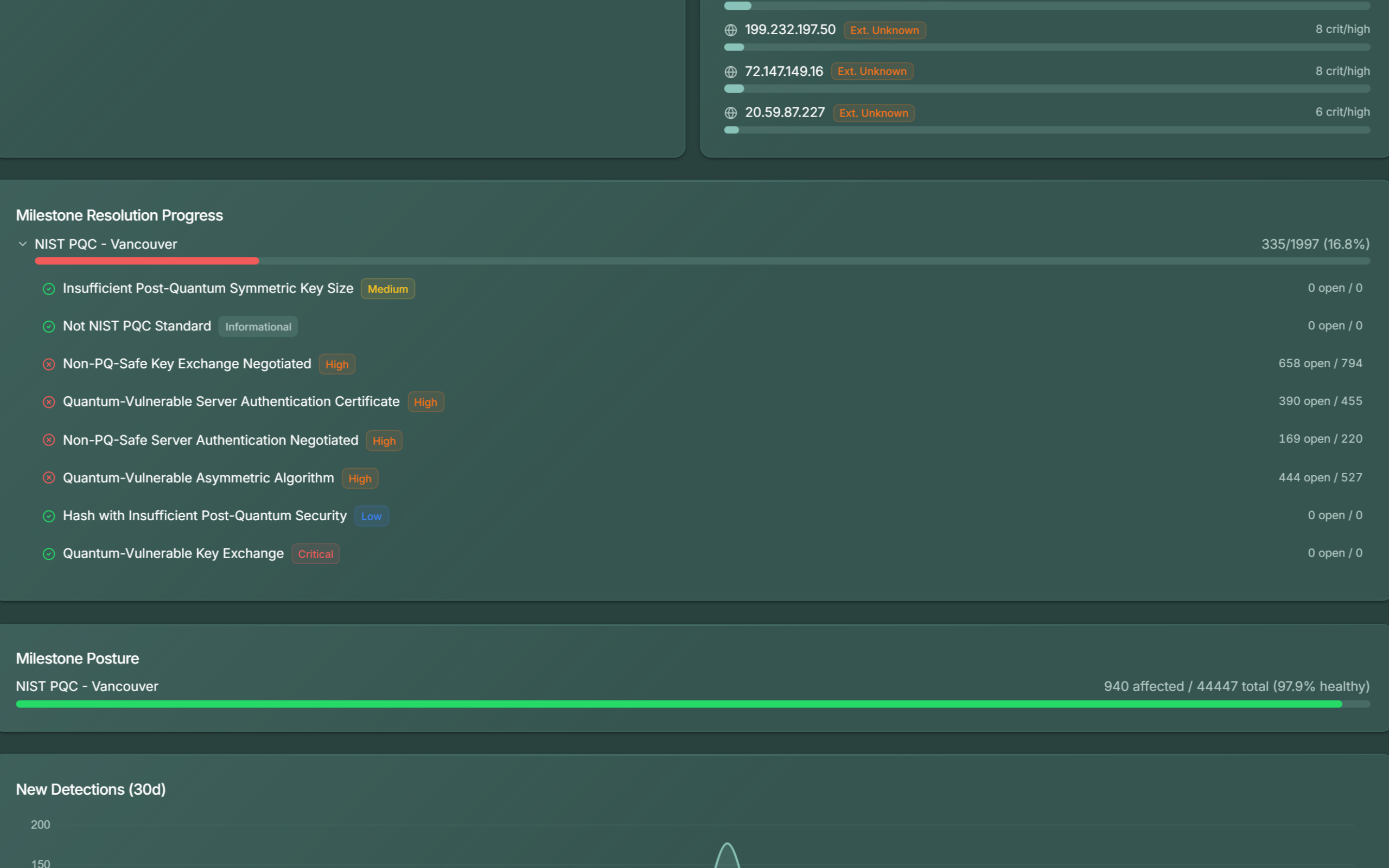
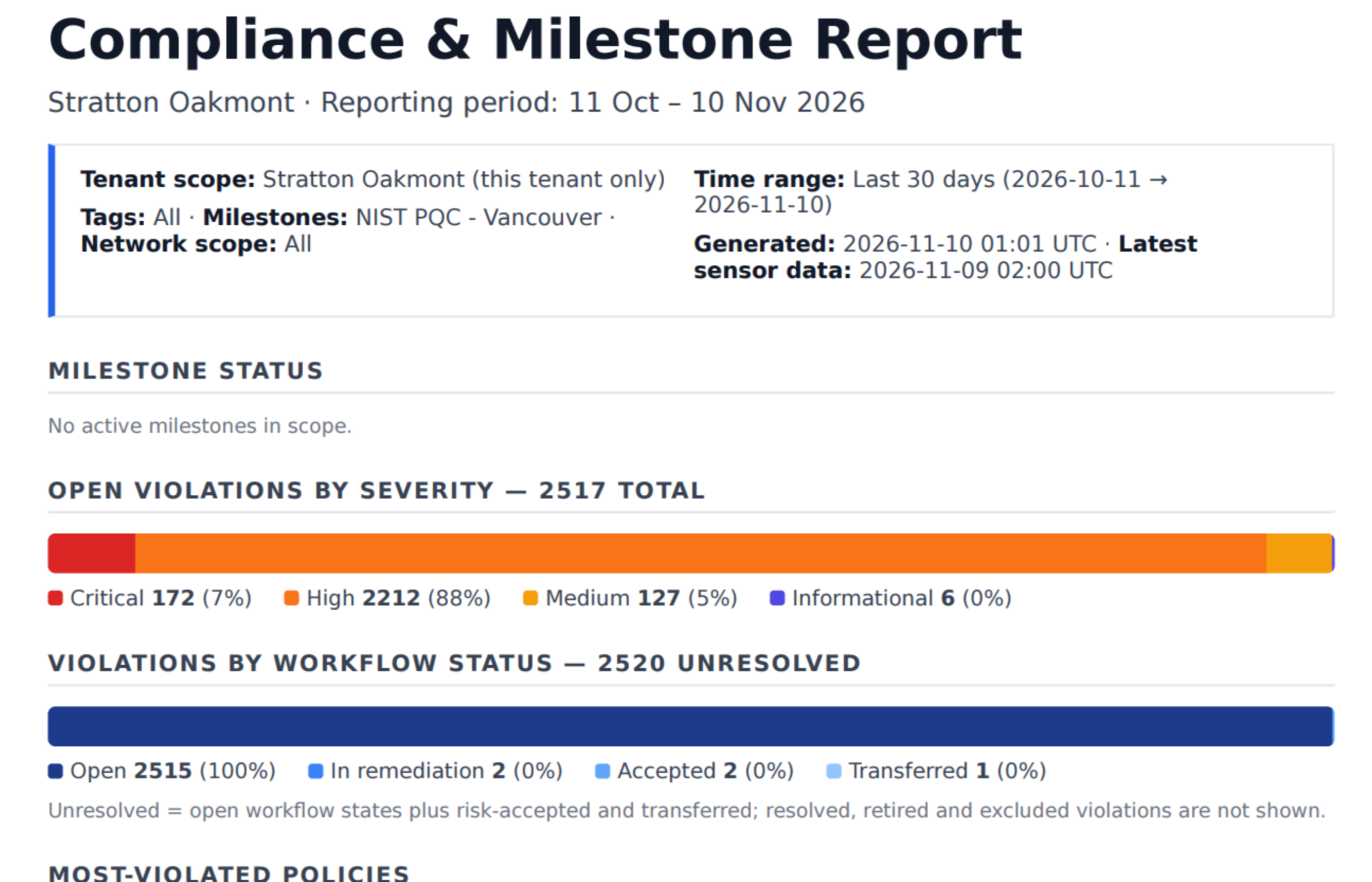
Every NIST-aligned migration plan starts with an inventory. CONTINUUM builds it, identifies the quantum-vulnerable algorithms across your estate, and tracks progress against milestone deadlines. The Compliance PDF shows burn-down and days remaining for each milestone.
Audit and compliance evidence
Hand auditors the inventory they ask for
PCI DSS v4.0.1 asks for an inventory of trusted keys and certificates (Req. 4.2.1.1) and of the cipher suites and protocols in use, reviewed at least annually (Req. 12.3.3). For most payment and card data environments, that inventory doesn’t exist in any reliable form. CONTINUUM discovers the cryptography on your hosts and across your network, evaluates each asset against policy, and shows what’s out of policy in priority order. CBOM, CSV and PDF exports put the inventory and its policy status in one place.
Shadow cryptography
Find the cryptography nobody recorded
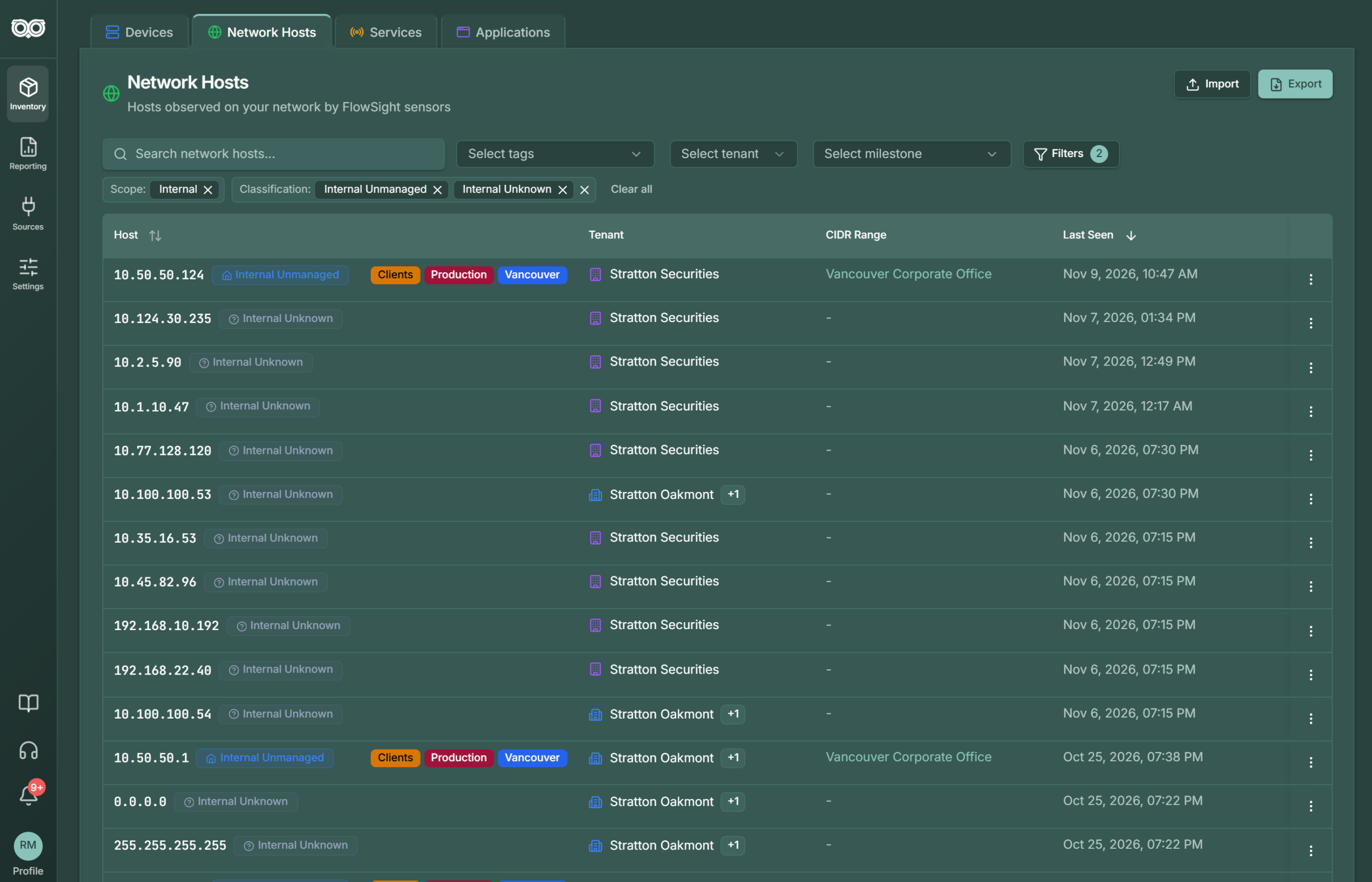
Certificates no lifecycle tool issued, SSH keys on hosts nobody inventoried, and devices no agent can reach. FlowSight reads the TLS those devices negotiate from mirrored traffic, so they enter the inventory without an agent.
Change detection
Catch weaker cryptography when it appears
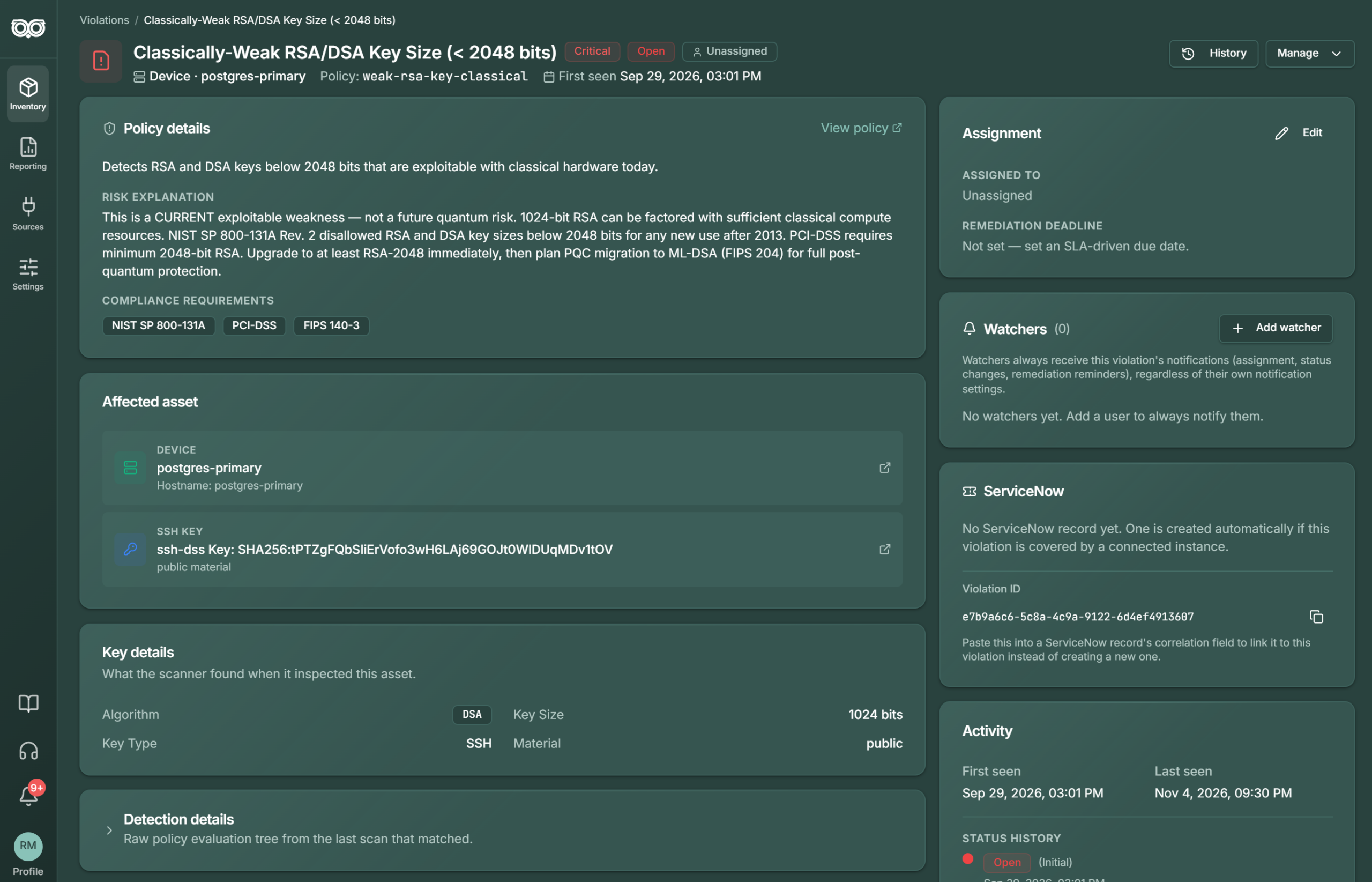
Every change re-enters evaluation. A renewed certificate with a weaker key, or a new service negotiating TLS 1.0, opens a violation when the sensors next report it, rather than at the next assessment cycle.
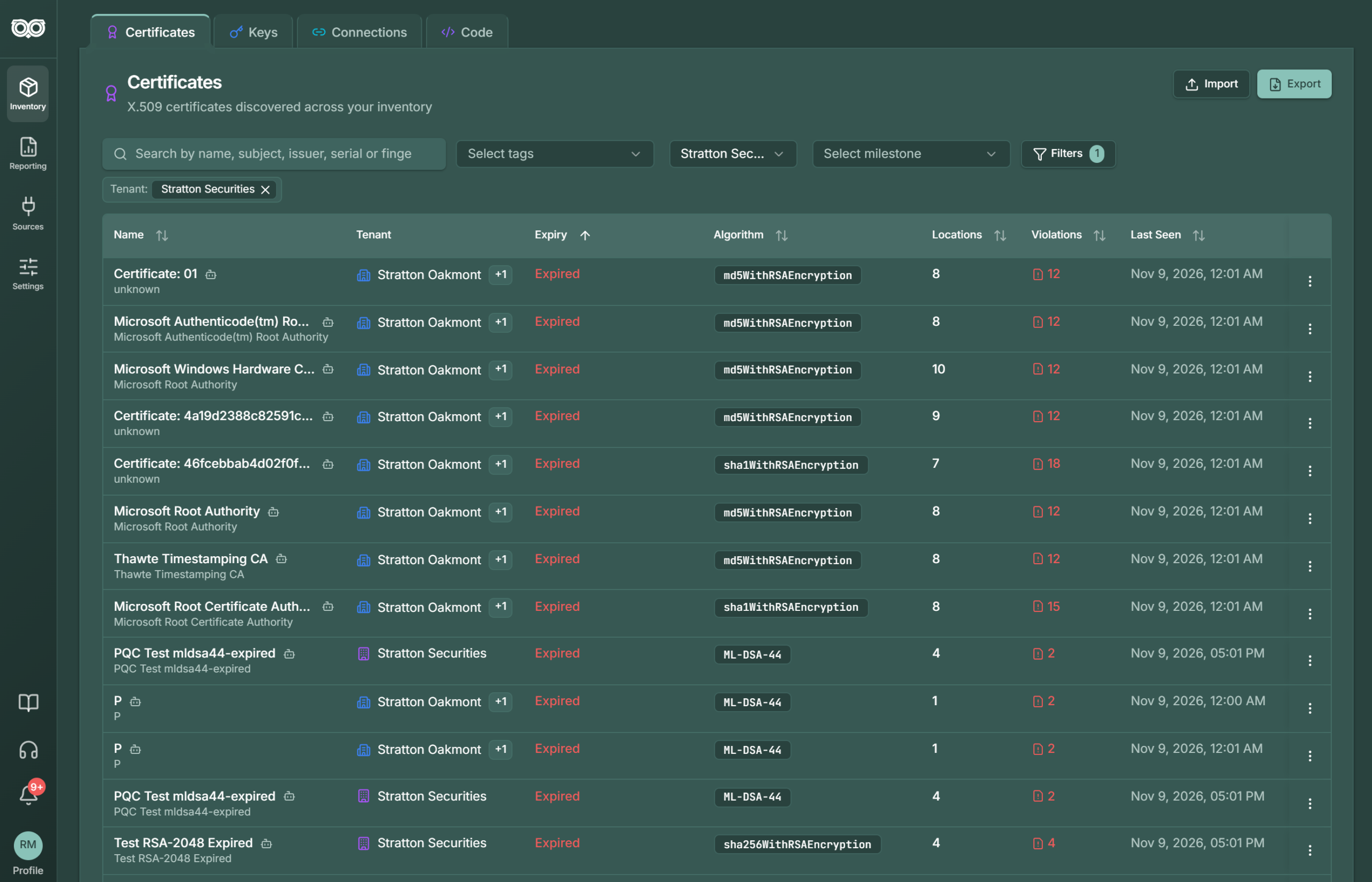
Certificate expiry and weak ciphers
Fix today’s weak spots, with or without a PQC program
Expiring certificates, deprecated algorithms and weak cipher suites are operational risk today, whatever your post-quantum plans. The same policies, milestones and violation lifecycle track them.
By industry
What each industry inventories first
The starting point differs by sector. The platform and the evidence don’t.
Payment platforms and API gateways
TLS certificates and negotiated cipher suites across payment platforms and API gateways, with CBOM and inventory evidence for PCI DSS audits.
Clinical systems, seen passively
Passive TLS discovery across EMR, imaging, and connected medical systems, with no agents on devices, plus certificate inventory on clinical servers.
Plans and reauthorization
Inventory and CBOM for OMB M-26-15 plans and reauthorization, and the quantum-vulnerable algorithms in use across hybrid environments.
Management systems, left untouched
Passive discovery of the TLS that management systems negotiate, without touching operational devices.
Network nodes and management planes
Certificates and negotiated protocols across network nodes and management planes, observed passively.
Requirements
Evidence toward each requirement
CONTINUUM produces evidence; it doesn’t make you compliant. Your auditor or partner maps it to your framework.
| Requirement | What it asks for | What CONTINUUM produces |
|---|---|---|
| OMB M-26-15 (U.S. federal agencies) | An inventory built with automated tools in a central CBOM; automated inventory management, policy enforcement and compliance reporting; the systems that can’t support PQC yet | Continuous sensor discovery, CycloneDX CBOM export, active policies that open violations automatically, Posture and Compliance PDFs, and exclusions with a justification for systems that can’t move yet |
| PCI DSS v4.0.1 | An inventory of trusted keys and certificates (Req. 4.2.1.1) and of the cipher suites and protocols in use, reviewed at least annually (Req. 12.3.3) | Certificate and key inventory from CipherSight, negotiated cipher suites and protocols from FlowSight, and CSV and CBOM exports as the documented inventory |
| NSA CNSA 2.0 | CNSA 2.0 algorithms for new national security system acquisitions from January 1, 2027 | Shipped policy rules reference CNSA 2.0, and a milestone can hold them against that date |
| NIST FIPS 203, 204 and 205, SP 800-131A, SP 800-52 | Approved algorithms, key lengths and TLS configuration | Shipped policy rules evaluate against them |
Start with your own environment
A four-week proof of value on a representative part of your environment produces a CBOM, the quantum-vulnerable algorithms in use, the PQ readiness percentage and the Posture and Compliance PDFs.